See everything.
Miss nothing.
MergerGod is the AI that drives your deal. Built on the Buyer-Led M&A framework, 400+ practitioner interviews, and thousands of real deal lessons, it reads your entire room and connects what siloed teams never can: the customer finance is counting on is the one legal found a change-of-control clause on.
What's your thesis?
Type the thinking behind any deal you're weighing: an acquisition, a partnership, a license, or a JV. MergerGod shows how it would structure the diligence against it. Sample data, no sign-up.
- Revenue is real, recurring, and durable enough to support the multiple
- The customer base is a viable beachhead, not a concentrated, churny niche
- The business survives the founder leaving
- Contracts and IP are clean and survive change of control
- What is the split between true recurring ARR and one-time implementation fees?
- How concentrated is revenue in the top three accounts?
- Which contracts carry change-of-control or assignment consents?
- How much of the pipeline depends on the founder's relationships?
So, what is MergerGod?
An AI that runs buy-side diligence. Connect your data room and it reads every document, threads each finding to your thesis, verifies it across two models, and carries it through to the agreement and the integration plan. Ask it anything, or let it run the deal and bring you the calls.
Connect the room
Upload from any VDR. It reads the whole room, every common format, including the files no one opens.
It threads the deal
Every finding mapped to your thesis, checked by a second model, and cited to the exact document and page.
You make the calls
It surfaces the decisions that need a human, with the evidence and the trade-offs already in hand.
This is called MergerGod for a reason.
Human diligence runs in silos. Finance reads the financials, legal reads the contracts, and nobody holds both at once. MergerGod holds the entire deal in one head.
It holds the whole deal at once.
Patterns, anomalies, and dependencies only appear when finance, legal, commercial, and technical evidence sit side by side. The concentration risk in the ARR schedule and the change-of-control clause on that same customer become one finding, not two reports nobody reconciled.
It tells you what belongs in the agreement while you can still negotiate it.
Every material risk maps to the protection that neutralizes it: the earnout, the holdback, the rep, the indemnity. The deal lead walks into legal with the terms and the evidence assembled, instead of working backwards to reconstruct why a clause matters.
It plans integration before you are allowed to staff it.
Deal sensitivity keeps integration people out until late, so planning starts after the value is already at risk. MergerGod builds the plan from the findings as they land, so day one starts warm instead of from scratch.
It runs the Buyer-Led playbook, not a generic model's instincts.
The Buyer-Led M&A framework, 400+ recorded practitioner interviews, and thousands of real deal lessons, encoded as named rules and cited precedent. It brings the judgment of the best acquirers to a team that has done a fraction of the deals.
Every other AI tool waits for your question. That is the ceiling: a chat box can only answer what you already knew to ask, and the risk that kills a deal is almost never the thing you thought to look for.
MergerGod asks first. Your thesis generates the plan, and the plan generates the questions the best acquirers would ask about this specific deal, each tied to the pillar it protects. You answer the room. It tells you what the room should have been asked.
The room, running on your thesis.
Not a chat box bolted onto a data room. A workspace for the whole deal, where every finding and readout threads back to why you are buying.
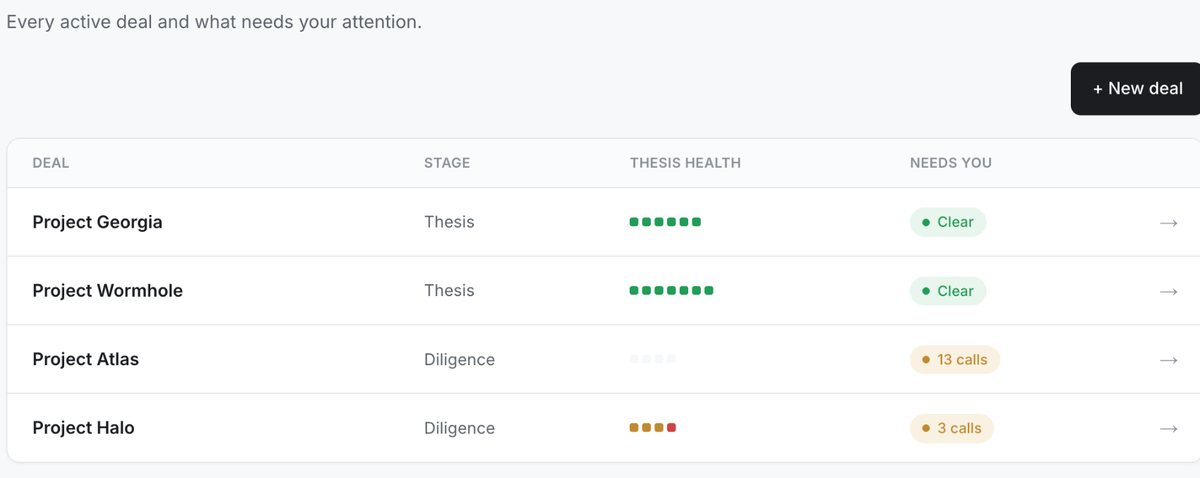
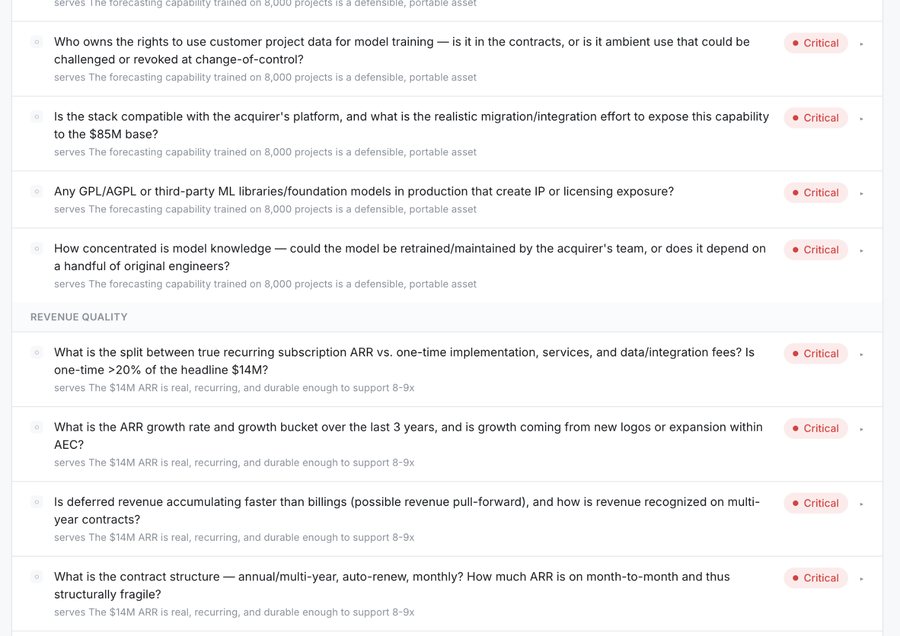
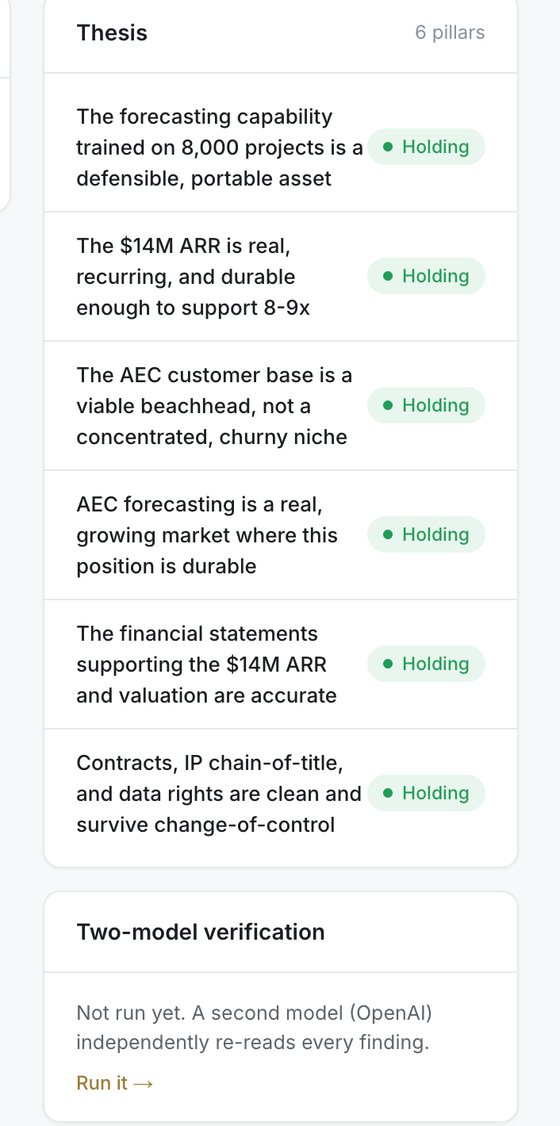
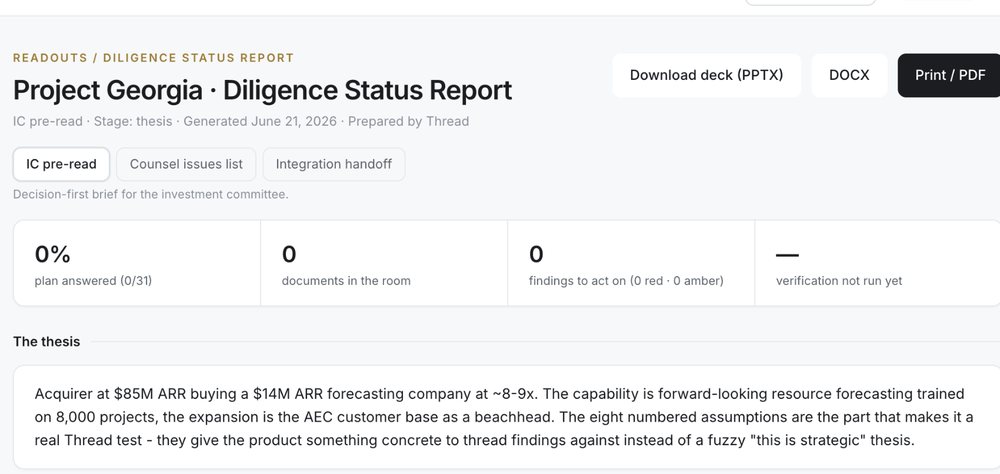
Every deal starts as a thesis. Most teams lose it by week two.
It gets buried under a thousand documents. The team starts answering questions instead of testing the bet. By close, no one quite remembers why they are buying. The deal does not fail at the table. It fails because the thesis quietly disappeared, and integration inherits a deal nobody is steering.
Every other tool organizes around the documents. MergerGod organizes around your thesis.
Ask a copilot a question and it answers from the pile. The thesis, the reason you are doing the deal, lives in someone's head and slowly fades. MergerGod inverts it. The thesis is the spine, and every document, finding, risk, and decision hangs off it.
Document-first
Organized around files, questions, and tasks. You drive, it waits to be asked. The thesis is yours to remember, or to lose.
Thesis-first
Organized around why you are buying. Every finding is threaded to a pillar, carried to the agreement and the plan, and graded after close. This is Buyer-Led M&A: you lead from your thesis, not the seller's room.
One pillar. Followed all the way, and back.
Pick a thesis pillar and watch a single finding thread through the whole deal: into diligence, the model, the agreement, and the integration plan, then loop back to re-score the thesis. That loop is what "never drops the thread" means.
Ask it anything. Or let it run the deal.
Both, wired together. Every question you ask feeds the plan it is already building. Every finding it surfaces is one click from "tell me more."
It is right there.
Pull any answer from the room in seconds, every claim cited to the source. The fast, prompt-and-answer surface you already want.
It is already working.
Point it at the room and it runs diligence autonomously against your thesis, surfacing the calls that need you instead of waiting to be asked.
It never waits to be asked, and it never drops the thread.
Bold, not reckless.
Autonomous where it can be. Human where it must be. Autonomy in a deal only works if you can check it, so everything MergerGod surfaces is built to be verified, not taken on faith.
Cited to the source
Every claim links back to the exact document and passage it came from. Click through and check.
Re-derived by a second model
Every material finding is independently re-read by a different AI model. Where they disagree, we show you instead of hiding it.
The decision stays yours
MergerGod does the reading and surfaces the call. It never makes it. The judgment is always a human's.
Whether it is your first deal or your fiftieth.
It holds the thesis you already have.
You do not have to write anything new. MergerGod enforces your thesis across a thousand documents and six months of deal work, and catches what a rushed read misses. The part you cannot do by hand.
It runs the process a seasoned acquirer would.
You do not need to know what an earnout or a TSA is. MergerGod runs the deal the way someone who has done fifty would, and tells you where you need to decide.
The models are commodity. The judgment is the product.
Five layers sit above the model. Together they are why a finding holds up in front of a committee.
- Reads the entire room, threaded to your thesis
- Two-model verification, cited to the source
- Question generation from the Buyer-Led framework
- Agreement mapping and integration planning
- Living readouts and post-close grading
- Deal documents drafted: NDA, LOI, and the terms behind the agreement
- Quality-of-earnings analysis, and a cross-read of the one you were handed
- A dollar impact on every finding, into price and structure
- Native VDR connections, beyond direct upload
The vision is the whole deal, in one thread. The page only claims what we can show you today. Everything else is the thread, still unfolding.
Put your next deal on MergerGod.
Start free on a live deal. Connect a room, set your thesis, and watch it work. No card required.